
Company
Platform
Insights

Noetik, an AI-native biotechnology company pioneering self-supervised machine learning and high-throughput spatial data to develop next-generation cancer therapeutics, today announced that in a retrospective study its multimodal AI foundation model, TARIO-2, identified patients with improved response and survival outcomes after treatment with botensilimab and balstilimab (BOT+BAL) a next-generation immune checkpoint inhibitor (ICI) combination, using only routine pretreatment histology (H&E) images. The findings are detailed in Noetik’s new white paper, "Foundation AI Models for the Prediction of Therapeutic Response to Next Generation Immune Checkpoint Inhibitors," authored in collaboration with Agenus.
The results take direct aim at one of oncology’s most persistent challenges: identifying which patients are likely to benefit from a given treatment. Clinical drug development is notoriously risky, in part because therapeutic benefit is often concentrated in patient subgroups that are difficult to identify before treatment. This challenge is especially pronounced in immuno-oncology, where the determinants of response vary by therapeutic mechanism of action, depend on broader tumor immune biology, and are rarely fully captured by a single biomarker.
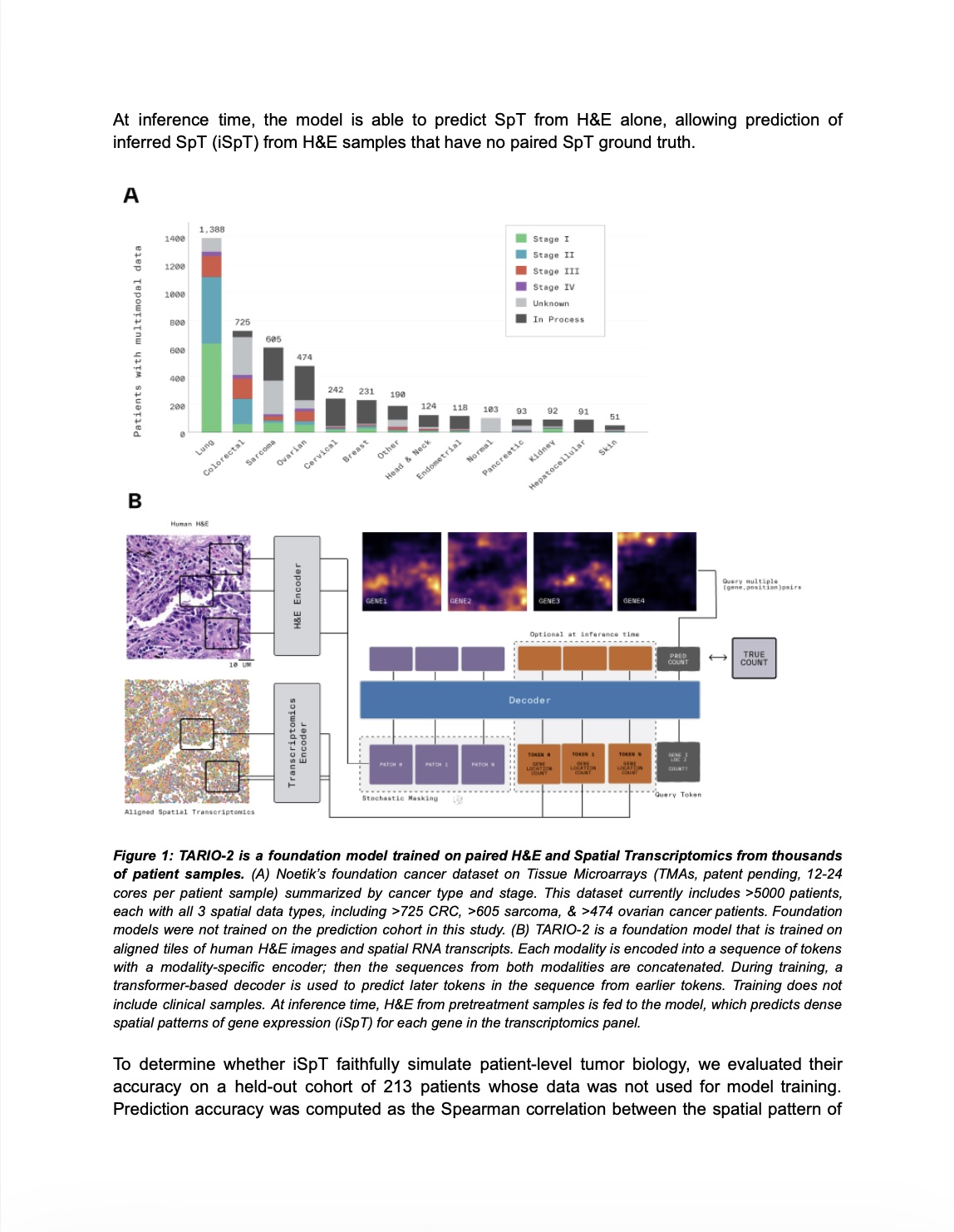
TARIO-2 represents a promising approach to addressing this knowledge gap. The model was trained on thousands of human cancer samples across 19 cancer types, learning the relationship between standard pretreatment pathology (H&E) images and high-resolution spatial transcriptomics data. At the time of use, it requires only an H&E slide, the same type of biopsy image routinely collected in clinical care, to generate a detailed picture of tumor biology that would otherwise require expensive, difficult-to-obtain molecular testing.
The ability to potentially identify likely responders from a standard biopsy image could be used to enrich patient populations in clinical trials, redirect likely non-responders to more appropriate treatments sooner, and potentially expand effective drugs into earlier lines of therapy.